
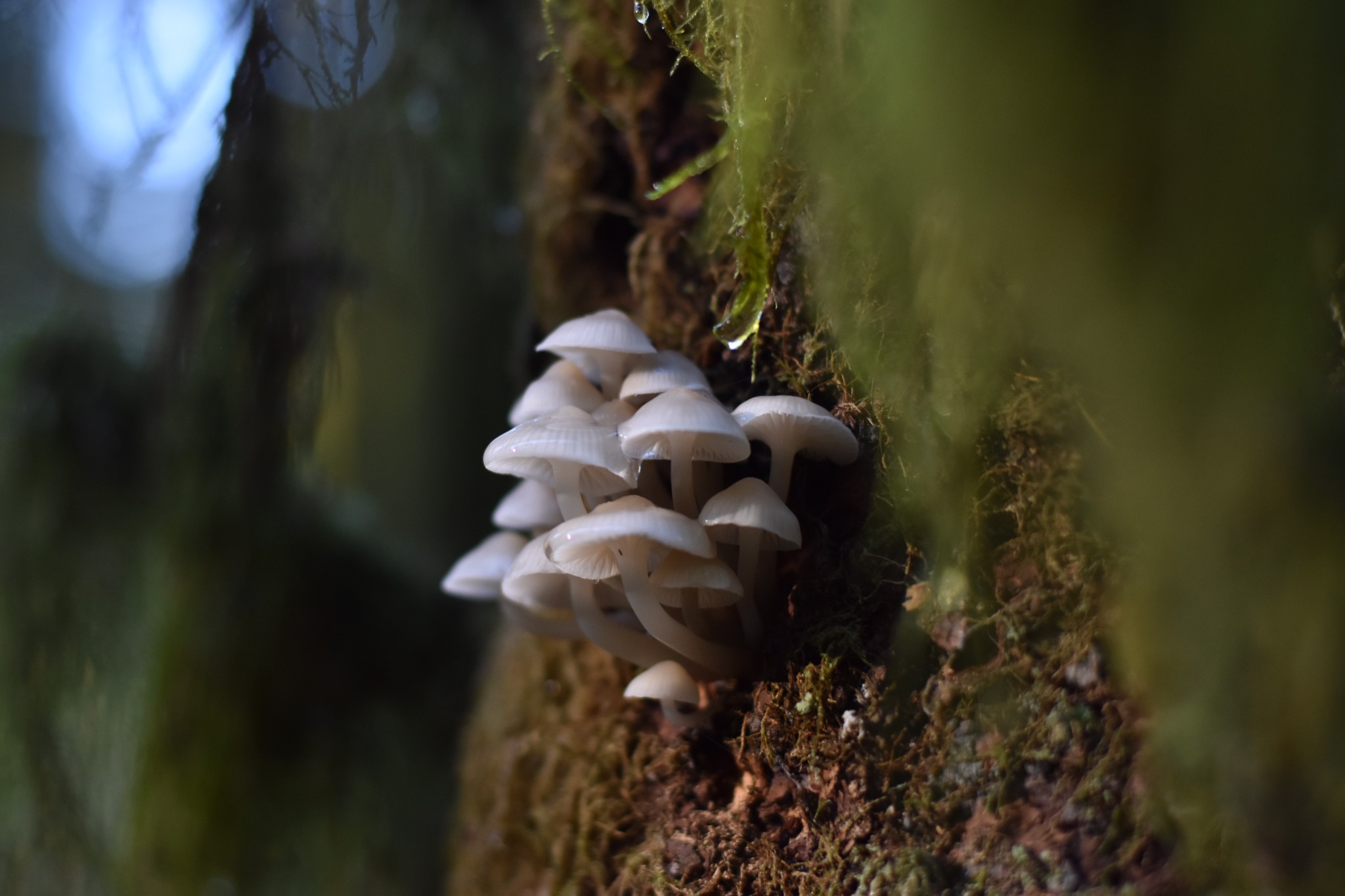
This is why I’m starting a blog about belonging, design, and the quiet systems shaping how we connect in the world. And no, it won’t always be about mushrooms – but they’re a surprisingly good place to begin.
You know that feeling when something just clicks, but you can’t explain why?
A moment, a place, a person, or a piece of design that feels like home – before your brain can put words to it. That’s the strange magic of belonging. And lately, I’ve started to realize: it’s a lot like mushrooms.
Stick with me.
The mushroom body is just the part we see. The real magic of it all? It’s underneath – invisible but alive. That underground network, called mycelium, is quietly connecting trees, passing nutrients, recycling decay, and reshaping entire ecosystems. It’s wild, intricate, very much weird – and it’s everywhere once you start looking for it. Also, it’s just amazing.
And that’s what belonging feels like to me.
Something appears above the surface – a conversation, a team, a story, a smell – and suddenly we feel connected. But that feeling? It’s rooted in something deeper: culture, memory, identity, stories, policies – the systems that make up our world. It’s the things we often don’t see, but always experience.
Why This Blog Exists
In my life and career, I’ve always been fascinated by how systems affect culture. Over time, however, this quiet curiosity has turned into a bigger exploration. It’s what I think about daily. I went back to graduate school late in life for Organizational Psychology to deepen my love for how systems shape culture – and, in a more tangible sense, the success of organizations both small and global.
It was never just about onboarding at a business for me – it goes much deeper.
This is a space for me to ask questions, make connections, and explore the ways in which we feel that sense of belonging in the world. Even if it means looking at fungi to create unique ways of approaching the complexity of it all.
Because belonging is more than a warm fuzzy emotion. It’s a biological and fundamental need, shaped by how we experience our surroundings. It’s also weird. It’s complex and often not really understood. It’s shaped by who we are, where we’ve been, and what’s happening around us – even when we don’t realize it.
The best part – everyone feels a sense of belonging. It’s neutral. It’s neither good nor bad, it just simply – is.
I also believe that understanding it on a deeper level is what can help us identify ways to strengthen that sense of belonging for each and every person – without tearing down that sense for others.
The thing is, like mushrooms, belonging grows in specific conditions for each individual person. While mycelium has specific conditions like moisture, shade, and decay – often invisible, but incredibly influential – the systems in our world are what both create that sense of belonging on an individual and collective level. And in turn, our individual and collective sense of belonging is what shapes the systems moving forward.
It’s weird. It’s complex. And honestly – it’s kind of amazing.
How I Got to This Point
In 2022, I picked up Geoffrey Cohen’s Belonging: Bridging Divides and Building Connection – on a whim. I was visiting Seattle for my mother’s brain surgery (she’s doing amazing, by the way), preparing to re-enter the life of a full-time grad student for Organizational Psychology as a 36-year-old, and most importantly – wanted something to deep dive into on the 5-hour plane ride back to North Carolina. Somewhere mid-flight, something clicked. Cohen gave language to what I’d always felt but couldn’t name.
Belonging.
To be honest – and I think many people can relate – I never really looked at belonging as more than a vague word to describe a feeling. But when you approach it for what it is – a fundamental human need – I (and maybe you) realize there’s so much more to it.
I’ve always been drawn to belonging – I just didn’t have the language or science for it. Why do some things pull us in while others push us away? Why do some places feel safe and welcoming to some, but not to others?
Whatever that “pull” is, I never saw it as good or bad. It just was. And I wanted to understand it.
But for a long time, I hesitated to ask those deeper questions. I worried about being labeled the “devil’s advocate” – a phrase often met with eye rolls and defensiveness. In a divided world, even trying to understand opposing views can feel risky. But I wasn’t trying to take sides – I was trying to understand how people connect (or disconnect) from the systems they’re part of.
A little less than two years after that plane ride back from Seattle, I was deep into my capstone research paper. I was reading the work of Cohen and many others, and one theme kept surfacing: systems.
Belonging, I realized, isn’t just a personal emotion. It’s a subjective experience within a system – a dynamic one. At that moment, I was writing about it through the lens of Universal Design, but really, I was chasing a bigger question:
How do systems shape our sense of belonging – and how does that sense of belonging reshape the systems we live in?
The Mycelium of Systems
Early in my career—usually summed up with the catch-all term organizational development—I became fascinated by how systems quietly shape the way we live, connect, and belong.
We move through systems all the time: onboarding at work, city layouts, school hallways, policies, social media platforms. They’re like the invisible scaffolding of our daily lives – quietly guiding behavior, flow, and interaction. And they’re always evolving.
That’s exciting. But it’s also complex.
Systems shape culture, and culture reshapes systems.
That feedback loop is a kind of living network – responsive, adaptive, and always beneath the surface.
It’s what makes one workplace feel empowering and another feel alienating. One city feel alive, another closed off. One conversation feel like an opening, another like a wall.
Like a mycelium network, these systems are rarely centralized.
They spread through signals, relationships, and environmental conditions.
We don’t just passively live in them – we interpret them, absorb them, and respond to them.
And in doing so, we carry those patterns into other spaces, often without realizing it.
Belonging isn’t just internal. It’s systemic.
It lives in design, language, architecture, story, and culture.
And once I started seeing it that way – like a thread running through every room I entered – I couldn’t unsee it.
“Organized” Took On a New Meaning
As I dug deeper—through complexity science, Universal Design, and works like Scale by Geoffrey West—I realized:
Belonging isn’t random. It’s emergent.
In complexity science, organization isn’t about control.
It’s about how patterns emerge, adapt, and evolve.
That clicked with me.
Because belonging isn’t just about emotion. It’s about structure – and the dynamic relationship between people and systems, especially as those systems scale.
Like mushrooms, it grows at the intersection of environment and connection. And when enough people feel it, they create structures to protect it – think culture, language, policy, rituals, and so forth.
Over time, those structures harden. They stop feeling like design.
They start feeling like “just the way things are.”
That’s why systems matter.
They don’t just hold us – they shape us. And we shape them right back.
The Meaning Behind Organized Belonging
To me, Organized Belonging is a conceptual exploration of how the human need to belong is shaped by the design of systems – and how that subjective experience, in turn, influences how systems evolve and scale.
When people feel like they belong – to a team, an identity, a culture, or a cause – they often build systems to reinforce and protect that feeling. Usually without realizing it.
And once design becomes systematized, it stops feeling like design.
It starts to feel like “just the way things are.”
But systems aren’t fixed – especially when you zoom out.
They’re adaptive. Over time, they change based on who feels welcome and who doesn’t.
Language, policies, architecture, politics, norms – they’re all reshaped by the people within them.
But Why Mushrooms, Though?
Okay, like I mentioned before – this blog isn’t going to be about mushrooms, but I do hope to continue this analogy one day further. At its core, I want this blog – and the subsequent path forward – to find inspiration from around our world to help understand the connection between belonging, design, and systems.
But think about it.
Mushrooms remind me that the visible part is never the whole story.
They thrive in complexity.
They quietly remake forests.
They teach us to look beneath.
They’re weird and scientifically lovely – just like your sense of belonging.
Why I’m Writing
Over the past few years, my call to explore the correlation between belonging, design, and systems is consuming me. At the same time, I also know that I want to do so in a way that’s fun, unique, and creates a table where everyone can come to.
It’s my love for looking deeper into how one’s sense of belonging changes as systems scale and become more complex. From families and teams to companies, cities, and nations – and ultimately, the human species as a whole.
I’m not just exploring this out of curiosity (though yes, that’s part of it…).
I’m writing to help name what feels hard to name.
To give us a place to start asking better questions.
To move toward more intentional systems, grounded in difference, awareness, and design.
Because when we recognize that our sense of belonging – both individual and collective – shapes everything from policy and identity to architecture and exclusion, we can begin to see the systems around us for what they are:
Designed. Inherited. Experienced.
And, most importantly, capable of change.
So for today’s thought:
If belonging is a mushroom, systems are the mycelium.
And maybe – just maybe – we’re all part of the same network, quietly shaping the world beneath our feet.